When was the first computer invented?
There is no easy answer to this question due to the many different classifications of computers.
The first mechanical computer, created by Charles Babbage in 1822, doesn't really resemble what most would consider a computer today.
Therefore, this document has been created with a listing of each of the computer firsts, starting with the Difference Engine and leading up to the computers we use today.
Note: Early inventions which helped lead up to the computer, such as the abacus, calculator, and tablet machines, are not accounted for in this document.
When was the word "computer" was first used?
The word "computer" was first recorded as being used in 1613 and originally was used to describe a human who performed calculations or computations.
The definition of a computer remained the same until the end of the 19th century, when the industrial revolution gave rise to machines whose primary purpose was calculating.
First mechanical computer or automatic computing engine concept
In 1822, Charles Babbage conceptualized and began developing the Difference Engine, considered to be the first automatic computing machine.
The Difference Engine was capable of computing several sets of numbers and making hard copies of the results.
Babbage received some help with development of the Difference Engine from Ada Lovelace, considered by many to be the first computer programmer for her work and notes on the Difference Engine.
Unfortunately, because of funding, Babbage was never able to complete a full-scale functional version of this machine.
In June 1991, the London Science Museum completed the Difference Engine No 2 for the bicentennial year of Babbage's birth and later completed the printing mechanism in 2000.
Analytical EngineIn 1837, Charles Babbage proposed the first general mechanical computer, the Analytical Engine.
The Analytical Engine contained an ALU (Arithmetic Logic Unit), basic flow control, punch cards (inspired by the Jacquard Loom), and integrated memory.
It is the first general-purpose computer concept.
Unfortunately, because of funding issues, this computer was also never built while Charles Babbage was alive.
In 1910, Henry Babbage, Charles Babbage's youngest son, was able to complete a portion of this machine and was able to perform basic calculations.
First programmable computer
The Z1 was created by German Konrad Zuse in his parents' living room between 1936 and 1938.
It is considered to be the first electromechanical binary programmable computer, and the first really functional modern computer.
First concepts of what we consider a modern computer
The Turing machine was first proposed by Alan Turing in 1936 and became the foundation for theories about computing and computers.
The machine was a device that printed symbols on paper tape in a manner that emulated a person following a series of logical instructions.
Without these fundamentals, we wouldn't have the computers we use today.
The first electric programmable computer
Colossus Mark 2 The Colossus was the first electric programmable computer, developed by Tommy Flowers, and was first demonstrated in December 1943.
The Colossus was created to help the British code breakers read encrypted German messages.
The first digital computer
Short for Atanasoff-Berry Computer, the ABC began development by Professor John Vincent Atanasoff and graduate student Cliff Berry in 1937.
Its development continued until 1942 at the Iowa State College (now Iowa State University).
The ABC was an electrical computer that used more than 300 vacuum tubes for digital computation, including binary math and Boolean logic and had no CPU (was not programmable).
On October 19, 1973, US Federal Judge Earl R. Larson signed his decision that the ENIAC patent by J. Presper Eckert and John Mauchly was invalid.
In the decision, Larson named Atanasoff the sole inventor.
The ENIAC was invented by J. Presper Eckert and John Mauchly at the University of Pennsylvania and began construction in 1943 and was not completed until 1946.
It occupied about 1,800 square feet and used about 18,000 vacuum tubes, weighing almost 50 tons.
Although the Judge ruled that the ABC computer was the first digital computer, many still consider the ENIAC to be the first digital computer because it was fully functional.
The first stored program computer
The early British computer known as the EDSAC is considered to be the first stored program electronic computer.
The computer performed its first calculation on May 6, 1949, and was the computer that ran the first graphical computer game, nicknamed "Baby"
Around the same time, the Manchester Mark 1 was another computer that could run stored programs. Built at the Victoria University of Manchester, the first version of the Mark 1 computer became operational in April 1949. Mark 1 was used to run a program to search for Mersenne primes for
The first computer company
The first computer company was the Electronic Controls Company and was founded in 1949 by J. Presper Eckert and John Mauchly, the same individuals who helped create the ENIAC computer.
The company was later renamed to EMCC or Eckert-Mauchly Computer Corporation and released a series of mainframe computers under the UNIVAC name.
First computer with program stored in memory
UNIVAC 1101First delivered to the United States government in 1950, the UNIVAC 1101 or ERA 1101 is considered to be the first computer that was capable of storing and running a program from memory.
First commercial computer
In 1942, Konrad Zuse begin working on the Z4 that later became the first commercial computer. The computer was sold to Eduard Stiefel, a mathematician of the Swiss Federal Institute of Technology Zurich on July 12, 1950.
IBM's first computer
On April 7, 1953, IBM publicly introduced the 701, its first commercial scientific computer.
The first computer with RAM
MIT introduces the Whirlwind machine on March 8, 1955, a revolutionary computer that was the first digital computer with magnetic core RAM and real-time graphics.
The first transistor computer
TransistorsThe TX-0 (Transistorized Experimental computer) is the first transistorized computer to be demonstrated at the Massachusetts Institute of Technology in 1956.
The first minicomputer
In 1960, Digital Equipment Corporation released its first of many PDP computers, the PDP-1.
The first desktop and mass-market computer
In 1964, the first desktop computer, the Programma 101, was unveiled to the public at the New York World's Fair.
It was invented by Pier Giorgio Perotto and manufactured by Olivetti. About 44,000 Programma 101 computers were sold, each with a price tag of $3,200.
In 1968, Hewlett Packard began marketing the HP 9100A, considered to be the first mass-marketed desktop computer.
The first workstation
Although it was never sold, the first workstation is considered to be the Xerox Alto, introduced in 1974.
The computer was revolutionary for its time and included a fully functional computer, display, and mouse.
The computer operated like many computers today utilizing windows, menus and icons as an interface to its operating system.
Many of the computer's capabilities were first demonstrated in The Mother of All Demos by Douglas Engelbart on December 9, 1968.
The first microprocessor
Intel introduces the first microprocessor, the Intel 4004 on November 15, 1971.
The first microcomputer
The Vietnamese-French engineer, André Truong Trong Thi, along with Francois Gernelle, developed the Micral computer in 1973.
Considered as the first microcomputer, it used the Intel 8008 processor and was the first commercial non-assembly computer.
It originally sold for $1,750.
The first personal computer
In 1975, Ed Roberts coined the term "personal computer" when he introduced the Altair 8800. Although the first personal computer is considered by many to be the KENBAK-1, which was first introduced for $750 in 1971.
The computer relied on a series of switches for inputting data and output data by turning on and off a series of lights.
Altair 8800 Computer
The first laptop or portable computer
IBM 5100The IBM 5100 is the first portable computer, which was released in September 1975.
The computer weighed 55 pounds and had a five inch CRT display, tape drive, 1.9 MHz PALM processor, and 64 KB of RAM. In the picture is an ad of the IBM 5100 taken from a November 1975 issue of Scientific American.
The first truly portable computer or laptop is considered to be the Osborne I, which was released in April 1981 and developed by Adam Osborne.
The Osborne I weighed 24.5 pounds, had a 5-inch display, 64 KB of memory, two 5 1/4" floppy drives, ran the CP/M 2.2 operating system, included a modem, and cost $1,795.
The IBM PCD (PC Division) later released the IBM portable in 1984, its first portable computer that weighed 30 pounds.
Later in 1986, IBM PCD announced its first laptop computer, the PC Convertible, weighing 12 pounds. Finally, in 1994, IBM introduced the IBM ThinkPad 775CD, the first notebook with an integrated CD-ROM.
The first Apple computer
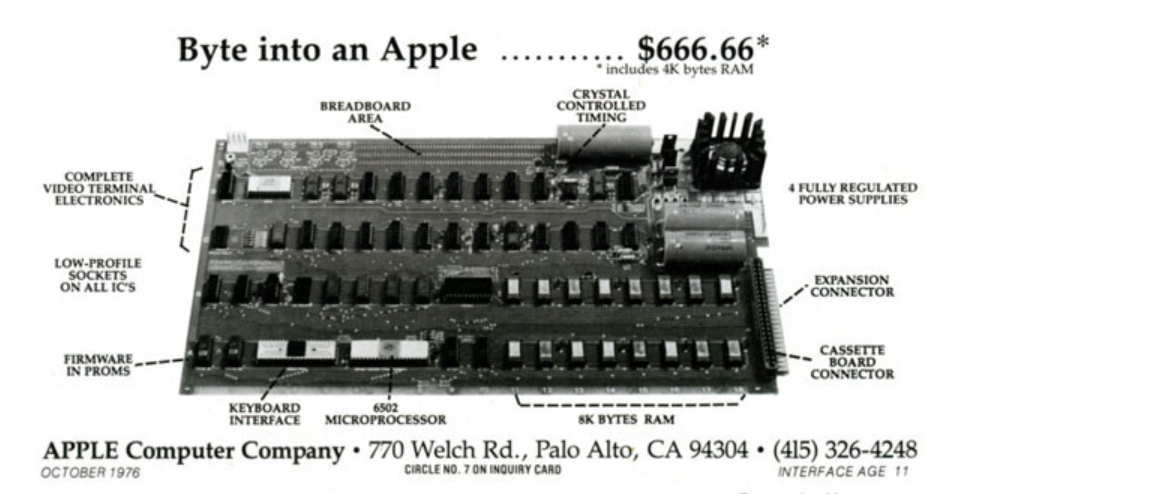
The Apple I (Apple 1) was the first Apple computer that originally sold for $666.66.
The computer kit was developed by Steve Wozniak in 1976 and contained a 6502 8-bit processor and 4 kb of memory, which was expandable to 8 or 48 kb using expansion cards.
Although the Apple I had a fully assembled circuit board the kit still required a power supply, display, keyboard, and case to be operational.
Below is a picture of an Apple I from an advertisement by Apple.
Apple I computer
Army Jobs - Navy Jobs - Military Jobs

Scholarship 2026/27
Current Scholarships 2026/2027 - Fully Funded
Full Undergraduate Scholarships 2026/2027
Fully Funded Masters Scholarships 2026/27
PhD Scholarships for International Students - Fully Funded!
Funding Opportunities for Journalists 2026/2027
Funding for Entrepreneurs 2026/2027

Scholarship 2026/27
Current Scholarships 2026/2027 - Fully Funded
Full Undergraduate Scholarships 2026 - 2027
Fully Funded Masters Scholarships 2026 - 27
PhD Scholarships for International Students - Fully Funded!
Funding Opportunities for Journalists 2026/2027
Funding for Entrepreneurs 2026/2027
***